

2025: Express Entry year in review – invitations issued, major developments
In 2025, we saw significant shakeups to Express Entry—Canada’s flagship application management system for those seeking to immigrate to the country.
This year’s Express Entry changes—most notably the removal of points for arranged employment and the restructuring of categories—had real implications for those who could expect to receive an Invitation to Apply (ITA) for permanent residence (PR).
Get a Free Express Entry Assessment
With 2025 in the rearview mirror, this article will cover which candidates were prioritized in 2025’s Express Entry draws, how invitations were distributed, and policy changes throughout the year.
Draw types and invitations issued
In 2025, Immigration, Refugees and Citizenship Canada (IRCC) issued a total of 113,998 Invitations to Apply (ITAs) across 58 Express Entry draws—15,195 more ITAs than were issued in 2024 over the course of 52 draws.
More than half (59%) of these issuances were through category-based selection, with the remaining ITAs distributed through Canadian Experience Class (CEC) and Provincial Nominee Program (PNP) draws.
From January to April’s end, the immigration department focused almost exclusively on CEC, PNP and French-language draws, then began diversifying its selection to include other category-based rounds—most commonly healthcare and social services.
You can view the number of draws per program and category, as well as the total number of ITAs distributed through each over the course of 2025 in the table below.
Category or programNumber of drawsNumber of ITAs issued
French-language proficiency948,000
Canadian Experience Class1535,850
Healthcare and social services714,500
Provincial Nominee Program2410,898
Education23,500
Trade11,250
Although only nine French-language draws were conducted in 2025 (representing about 16% of all draws), they accounted for the largest share of invitations overall, with each draw issuing between 2,500 and 7,500 invitations. This directly aligns with the federal government’s push for increased Francophone immigration outside Quebec.
While less commonly held, the remaining category-based draws invited candidates in 2025 Express Entry priority categories, to fill labour gaps across Canada—primarily healthcare and social services (also deemed to be priority sector by many PNPs this year). These draws issued a cumulative 19,250 ITAs across three draw types.
Following PNP draws (accounting for about 41% of 2025 draws), CEC selection (about 26%) was the most common at 15 draws, reflecting the federal government’s increased focus on prioritizing those already present in Canada for PR.
Absent from selection this year were Science, Technology, Engineering and Math (STEM) draws and Agriculture and agri-food draws—meaning candidates in these occupations would have had to been drawn through PNP draws (if possessing a nomination) or CEC draws.
There were also no general draws this year, as 2025 brought a shift to more targeted draws—the last general draw (which consist of all candidates in the Express Entry pool) was on April 23, 2024.
Month-by-month ITA issuances
The following table shows how many ITAs were issued throughout each month of 2025.
IRCC drastically increased the volume of ITA issuances from September through December, with most preceding months (all but February and March) seeing significantly lower distributions.
December saw the largest share of ITAs issued in any single month of the year, representing 17% of all 2025 issuances—and April the least (about 1%).
MonthNumber of ITAs issued
January5,821
February11,601
March13,261
April1,246
May2,511
June7,405
July7,558
August6,417
September10,018
October15,647
November12,991
December19,522
See how competitive your Express Entry profile is
CRS cut-offs by draw type
Comprehensive Ranking System (CRS) cut-off scores across 2025 Express Entry draws varied greatly across programs and categories, with most draw types seeing higher cut-offs than last year.
While Express Entry invitations are typically extended to the highest-ranking candidates, category-based selection provides eligible lower-ranking candidates with an opportunity to receive an invitation for PR.
Overall, category-based rounds typically featured lower cut-offs than other draw types (CEC or PNP), with French draws dipping the lowest—in the high 300s.
View the table below to see the highest and lowest CRS cut-off scores for each draw type held by IRCC this year.
Category or programCRS cut-off score range
French-language proficiency379–481
Canadian Experience Class515–547
Healthcare and social services462–510
Provincial Nominee Program699–855
Education462–479
Trade505
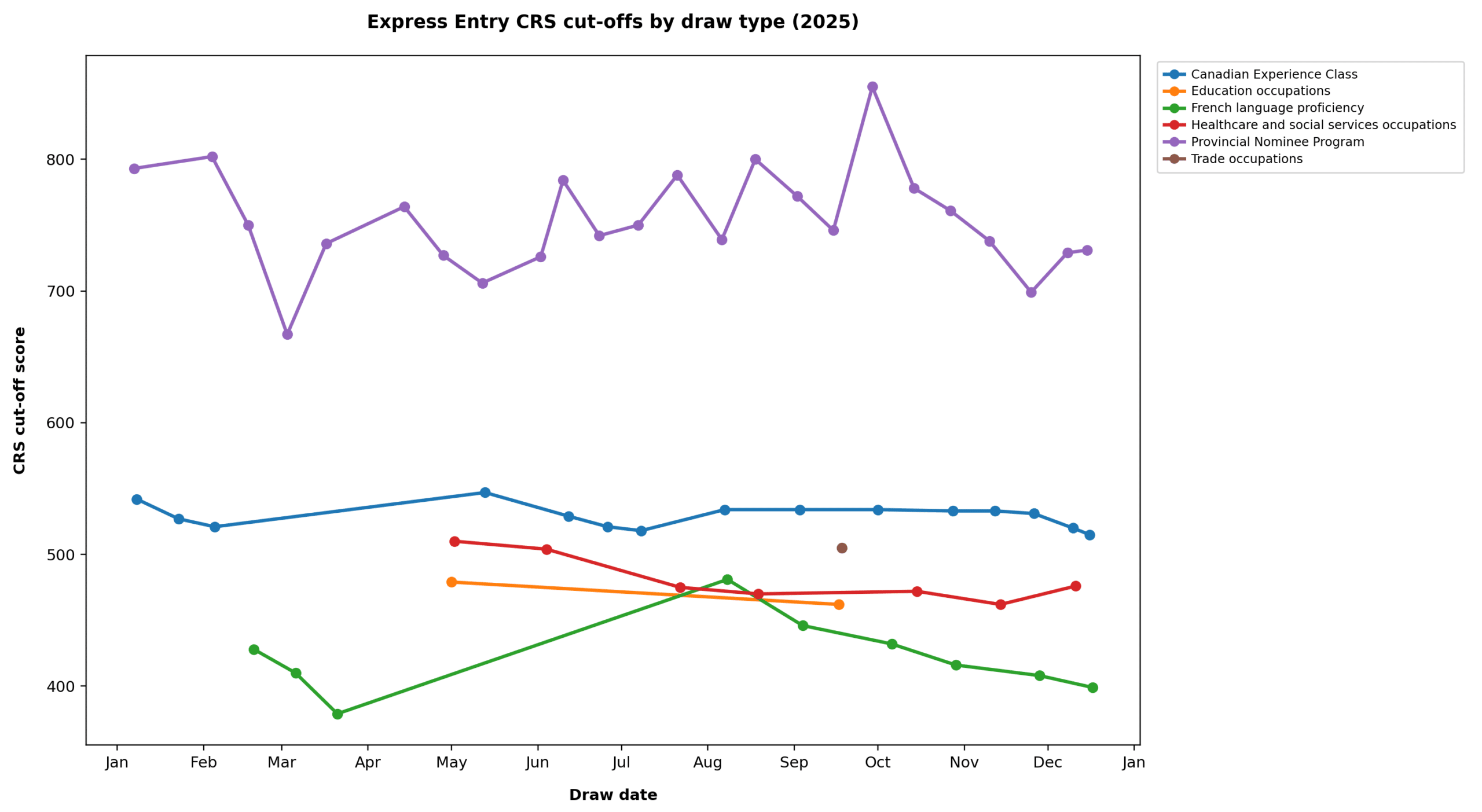
You can also see how CRS scores have progressed for each category and program in this line graph:
French draws likely featured lower CRS cut-offs than any other draw type due to the substantial number of invitations issued per round, and because of the limited pool size (comparatively), as one needs to reach an NCLC 7 to qualify.
A curious—and somewhat anomalous—trend was evident in this year’s CEC rounds in particular. Between August 7 and November 12, the cut-off remained essentially fixed at 533 or 534 for five consecutive draws, with 1,000 invitations issued each time.
And for two consecutive years now, the CRS cut-off scores for CEC draws peaked at 547 points—even after the removal of job offer points earlier this year (more on that below).
IRCC’s December draws generally saw lower CRS cut-offs than those reached throughout the year (e.g., 399 for French, 515/520 for CEC, 476 for healthcare) and large ITA issuances—likely as a result of the department trying to meet its admissions targets for 2026.
Major changes to Express Entry in 2025
IRCC has implemented numerous changes to Canada’s Express Entry system in 2025, which have impacted all foreign nationals wishing to obtain PR via this route—from the point of consideration to the time of application.
These policy shifts affected who could expect to receive an invitation in Express Entry draws, highlighted Canada’s priorities, and reshaped the candidate pool.
We’ve compiled a list of all the changes that came to Express Entry in 2025 below.
Increased permanent residence admissions through Express Entry
The 2025-2027 Immigration Levels Plan detailed a PR admissions target of 124,680, compared to 110,770 the year prior.
Unlike in 2024, PR admissions targets in the 2025-2025 ILP were broken down into two categories: “Federal Economic Priorities” and “In-Canada Focus.”
The In-Canada Focus category, allotted 82,980 admissions, makes up about 66% of all planned admissions, and primary consists of candidates invited through CEC and “other regional immigration pathways” (such as Express Entry-aligned PNPs).
Candidates under the Federal Skilled Worker Program (FSWP) and Federal Skilled Trades Program (FSTP) are also considered.
In short: this category signals that the federal government aimed to prioritize candidates within Canada in 2025, further evidenced by the frequency of CEC draws.
As for the Federal Economic Priorities category—which was allotted 41,700 admissions, this refers to candidates with “specific skills, training, and language ability” invited through category-based selection, to meet labour market needs.
Looking forward to 2026, PR admissions through all Express Entry programs and category-based selection (now conjoined), have decreased by over 12% (109,000 admissions).
Get a Free Express Entry Assessment
February shuffling of 2025 Express Entry categories
Perhaps the largest and most impactful change to Express Entry in 2025 was the complete overhaul of occupational Express Entry categories, and thereby, category-based selection.
On February 27, a new category was added (Education, with five eligible occupations), another was removed (Transportation), and all other existing categories were reworked—with numerous eligible occupations added or removed.
Healthcare, notably, was expanded to include certain social services occupations.
Category nameNumber of occupations addedNumber of occupations removed
Healthcare and social services86
Science, technology, engineering and math (STEM)619
Trade194
Agriculture and agri-food02
With this change, IRCC announced that the 2025 Express Entry priority categories would be French-language proficiency, healthcare and social services, trades, and education.
New category, immigration measures for physicians
IRCC introduced another category on December 8: “Physicians with Canadian work experience,” which consists of three eligible NOCs and requires individuals to have at least 12 months of Canadian work experience within the last three years, in a single occupation.
Draws under this category are to begin in early 2026, according to Immigration Minister Lena Metlege Diab.
The minister also announced two measures aimed at facilitating Canadian PR for internationally trained physicians, including:
Reserving 5,000 PR admissions spaces for provinces and territories to nominate doctors who have job offers (on top of regular PNP allocations); and
Expediting work permit processing (14 days) for doctors with a provincial nomination.
Removal of CRS points for arranged employment
In March 2025, IRCC announced that Express Entry candidates would no longer receive CRS points for arranged employment, resulting in 50 or 200 fewer points for candidates with a valid job offer.
This March 25 change applied to all new and existing profiles in the Express Entry pool, but not to those who already received ITAs or submitted PR applications.
When the former immigration minister, Marc Miller, first announced plans to remove job offer-based CRS points in December 2024, he noted this would be a temporary measure—though whether this continues to be IRCC’s intent remains unknown.
Candidates now need to submit upfront medical exams
From August 21, 2025, onward, Express Entry candidates must complete an Immigration Medical Exam (IME) prior to applying for PR through the Express Entry system—unless they meet certain exemption criteria.
Before this change, applicants could complete an IME after submitting their PR application and only needed to get one done if IRCC requested they do so.
Now, Express Entry PR applications must be accompanied by an Information printout sheet or an IMM 1017B Upfront Medical Report form.
Note: As for what we can expect from Express Entry in 2026, read our article covering the biggest upcoming changes in the new year.